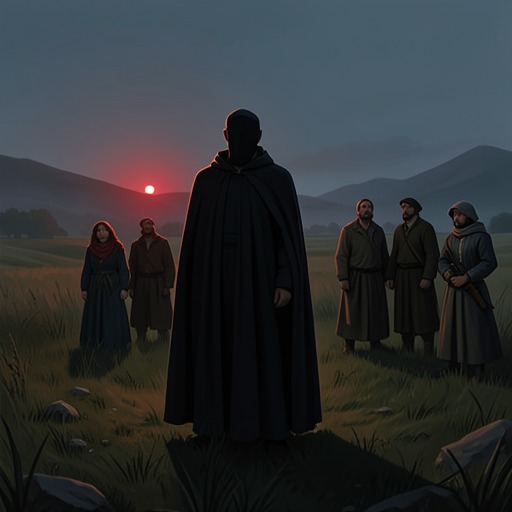
The Prince That Was Promised
A Clash of KingsThe Prince That Was Promised is an unresolved prophetic designation rather than a fully identified character. Its clearest formulation appears in Daenerys Targaryen’s vision of a royal birth, where a man named Aegon is presented as a king whose song is already made: he is the promised prince, and his is the song of ice and fire. The same vision immediately complicates any simple identification by adding that the dragon has three heads, while later voices address Daenerys herself as the mother of dragons and a child of three. The prophecy therefore joins royal succession, elemental opposition, and draconic plurality without closing the question of who, exactly, fulfills it.
Prophetic Appearance and Royal Memory
The figure first emerges through the imagery of a newborn prince. In the vision, a silver-haired man names the infant Aegon and calls him a king, while his mother asks whether a song will be made for him. His answer gives the prophecy its defining language: the child is the prince that was promised, and his song is the song of ice and fire. The scene binds promise to birth, kingship, and music, but it does not present the prophecy as a plain historical record. The family and child fade like morning mist, leaving only the harp’s sadness, so the revelation arrives as an image that is emotionally forceful yet resistant to literal explanation.
The name Aegon also places the prophecy inside the contested memory of Targaryen rule. The vision’s royal setting evokes a dynasty whose claims were repeatedly expressed through bloodline, conquest, and the symbolic power of dragons. Elsewhere, the political world treats descent and conquest as rival foundations of legitimacy. Renly Baratheon dismisses abstract genealogical arguments about the Iron Throne by recalling that Robert Baratheon won it with his warhammer; Robb Stark’s crown, by contrast, revives the lost imagery of the Kings of Winter. Against these competing claims, the promised prince represents a different kind of authority: not merely an inherited title or a military achievement, but a future charged with prophetic meaning.
The Dragon with Three Heads
The prophecy is inseparable from the image of the three-headed dragon. In the birth vision, the speaker insists that there must be one more and then declares that the dragon has three heads. This statement prevents the promised prince from functioning as a solitary heroic answer to history. Even when the vision appears to identify one child, its final image opens the possibility of a triadic destiny, shared agency, or multiple figures gathered beneath one draconic sign.
The later encounter with the Undying Ones intensifies that structure. Their disembodied voices call Daenerys the mother of dragons and a child of three; when she asks what three means, the answer returns to the dragon’s three heads. The surrounding revelations repeat the number across different domains: Daenerys must light three fires, ride three mounts, and know three treasons, each associated with a different human or existential condition. The recurrence makes three a pattern of obligation and danger rather than a decorative emblem. It suggests that the promised future will be reached through intertwined lives, choices, and betrayals, not through a single uncomplicated act of deliverance.
Ice, Fire, and Competing Claims
The phrase “the song of ice and fire” gives the prophecy its widest imaginative reach. Ice and fire are not explained as a single doctrine, and the text does not identify one person as their settled embodiment. Instead, the phrase resonates with the book’s divided political and cultural worlds. The North asserts independence under Robb Stark, whose new bronze-and-iron crown recalls the ancient Kings of Winter and whose declared kingdom includes the Stark lands north of the Neck and the Riverlands. The Greyjoy tradition looks backward toward the Old Way, while its words proclaim We Do Not Sow. Daenerys Targaryen’s dragons, meanwhile, carry the memory and violence of a lost conquering dynasty into a future that remains geographically and politically remote.
These claims show how prophecy and nationalism can operate through similar forms. Crowns, banners, ancestral names, and recovered histories turn present conflict into an apparently natural continuation of the past. The banner of the King in the North remains the grey direwolf of the Starks running across an ice-white field, while the Targaryen vision gives dynastic memory a mythic soundtrack of fire and ice. The promised prince belongs to this same process of historical imagination, but with an important difference: unlike Robb’s explicit borders or a conqueror’s visible throne, the prophecy cannot yet be possessed. It remains a language through which rival futures may be claimed.
An Open Prophecy
The text keeps the identity of The Prince That Was Promised deliberately open. Daenerys sees the name Aegon attached to the infant, yet the voices in the chamber simultaneously center her as mother of dragons and child of three. The vision also asks whether what she has witnessed belongs to the past or the future, truth or falsehood, and the Undying Ones answer in language of shadows and unmade morrows rather than in a clear chronology. The prophecy consequently produces knowledge without resolution: it changes what Daenerys and the reader can imagine while withholding the final correspondence between sign and person.
That openness is reinforced by the wider instability of vows and political legitimacy. Jaime Lannister argues that the demands placed upon a knight are mutually destructive: defending the king, obeying a father, protecting the innocent, respecting the gods, and obeying the laws can force one vow to violate another. The promised prince occupies a similarly unstable field of meanings. A sacred expectation may point toward a savior, a ruler, a bloodline, or a constellation of figures, while political actors continue to decide legitimacy through war, homage, crowns, and hostages. Even the Night’s Watch, confronted with threats beyond its jurisdiction, insists that it cannot set the world to rights because it has other wars to fight. The prophecy stands at the opposite extreme of that practical restraint, offering an immense future horizon whose demands and costs have not yet been made ordinary.
Narrative Significance
The Prince That Was Promised functions as a bridge between private vision and public history. Its most concrete appearance is intimate and familial: a man, a woman, a newborn, a harp, and a song. Yet the prophecy immediately expands beyond the chamber through the imagery of three dragon heads and the repeated triads of fires, mounts, and treasons. It therefore transforms a dynastic birth into a pattern capable of organizing the book’s broader conflicts.
Its decisive narrative effect is not to settle succession but to make succession inseparable from destiny. Robb Stark can be acclaimed King in the North, Theon Greyjoy can imagine restoring the Old Way, and competing Baratheon claims can be justified through either blood or force; beneath these struggles, the prophetic language of dragons suggests that the future may obey a design none of these rulers fully controls. The prophecy’s power lies precisely in that tension. It promises recognition while preserving uncertainty, and it turns the question of who will rule into the larger question of what kind of future the surviving heirs, dragons, and divided realms are moving toward.